HISTORY | STORIES | BEYOND BLOG & CREATE PEOPLE |
The BORAL Oil Refinery at MatravilleConstruction began in March 1947, using a site at Matraville near the corner of Bunnerong and Military Road which provided access to shipping links on Botany Bay. The project was ambitious for its time, reflecting Australia's determination to build sovereign refining capacity despite post-war shortages. It was launched amid post-war material shortages and relying heavily on repurposed naval and military equipment. The refinery's early workforce consisted largely of recently discharged Royal Australian Navy personnel because BORAL felt that the naval "shipshape" ethos and training were ideally suited to the refining industry. Caltex held a 40% stake and supplied the crude oil for processing.
Local Community Opposition
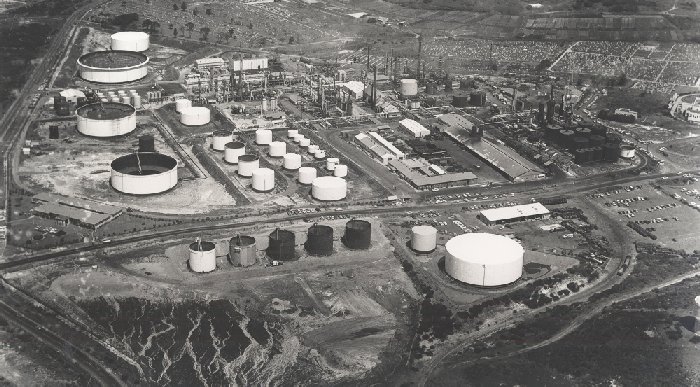 Boral Oil Refinery, Matraville, c1950
Commenced in 1948 Corporate changes reshaped the refinery's ownership through the 1960s and 1970s. BORAL formally adopted its acronymic name in 1963, then sold a 50% share to Total in 1968 and the remainder in 1972, after which the site operated as the Total Matraville Refinery. A major expansion followed in 1979, but the broader industry trend toward larger, more efficient refineries and rising fuel imports placed pressure on smaller metropolitan plants. The history section on BORAL's website (https://www.boral.com.au/about/our-history) gives an extensive treatment about history of the refinery, delving much more deeply into the operation and economics of the project over three decades. Though it became a substantial company in its own right, and was in partnership with multi-national corporations, it was always an uphill battle for a local company operating in a smaller market to be able to cope successfully with the macro-economics of the huge and complex international oil market.
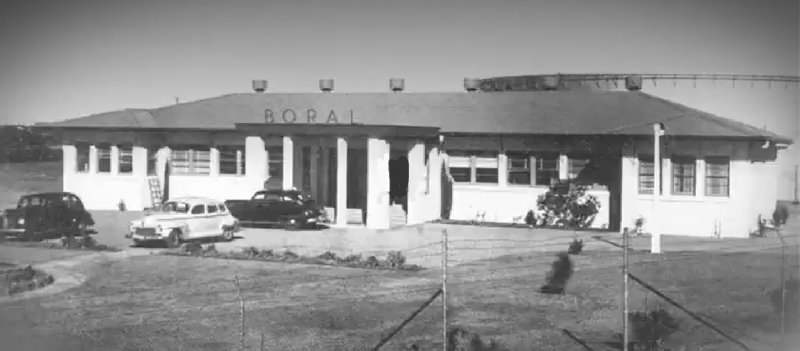 Boral Oil Refinery Offices, Matraville, 1948 The refinery ultimately closed in 1984, ending nearly four decades of operation. The site was demolished in 1988, leaving behind a legacy as a pioneering post-war industrial enterprise that helped shape both BORAL's corporate identity and Sydney's mid-century industrial landscape. Today only the Viva Victorian plant and the Ampol plant in Brisbane remain which produce about 20% of Australia's needs. As recently as 2000, eight oil refineries operated in the country and produced up to 98% of our petroleum.
Local Landmark
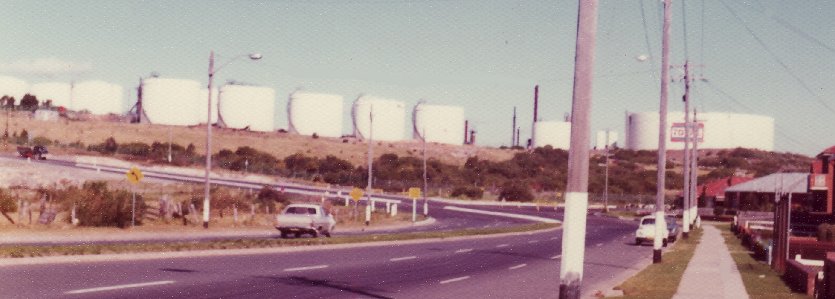 Total Oil Refinery, Matraville, c1965 (Bunnerong Road) The large flame of the refinery's flare stack, a critical safety device designed to burn off excess flammable gases and prevent dangerous pressure build-ups, burnt brightly in the night sky. At times it could be larger than normal causing a red glow in the sky that could be seen as far north as Randwick. Many an amateur ace reporter drove south to Matraville in the hope of a scoring a "scoop", only to find it was an unusually active flare stack.
Legacy The former refinery site, now with its entrances on Military Road, has been repurposed for ongoing industrial activities, primarily as a logistics and warehousing precinct proximate to Port Botany.
References
|
Copyright © Coogee Media All rights reserved
| CONTACT US | ABOUT US |