Coogee Media
HISTORY | STORIES | BEYOND BLOG & CREATE PEOPLE |
Australian Olympic FlagsAs everyone knows, Olympic Games opening ceremonies begin with the joyous parade of athletes marching behind their flag-bearers. The highlight for Australians is when the Australian team, usually large in comparison to most teams, enters the stadium under the Australian flag - the Australian blue ensign emblazoned with the Southern Cross. That's the way Australian participation in the modern Olympics since is often portrayed. It is often said that since the modern games started in 1896, and Australia is one of the few nations to compete at every summer games. That is not strictly true!
Collection of British Colonies Before 1901 For Games prior to 1 January 1901, Australian teams could not have competed under an "Australian" flag which did not yet exist, and anyway, technically, represented Australasian sports, which included New Zealand.
Australian Flag Finally Approved 1908
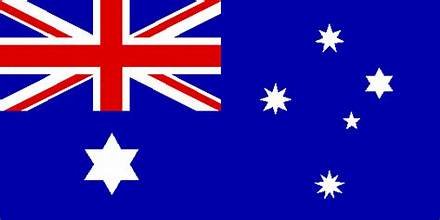 1901 interim version of the Australian flag Compare it to the final version approved in 1908 (below) The five joint winners of the flag design competition all produced designs strikingly similar to each other with the Union flag in the top left quarter and the left-hand side featuring a Southern Cross of five stars. In the lower left hand quarter was a large six-pointed star with each point representing one of of the federating colonies, or states. This design was submitted to various British authorities for approval (thus underscoring the fact that Federation did not represent independence from the British Empire). First up, the British admiralty took issue with the design having different numbers of points on the Southern Cross (9,8,7,6) to represent various degrees of intensity in the night sky because it made manufacture too difficult. The design was standardised with the four brighter stars having 7 points, and the smaller star, five points. Next up the King needed to take a look at it. George V, by all accounts a man of good taste and attention to detail, said that the six-pointed Federation star seemed to him unattractive and out of place. He also noticed that the Federation star sitting atop the Commonwealth Coat of Arms had a different design with seven points. So, on 8 December, 1908, the Commonwealth finally approved the Australian flag with a seven pointed federation star, after the end of the 1908 Olympics.
Not the National Flag The New Zealand flag with four five-pointed, red-coloured, white-bordered stars (Southern Cross) was an adaptation of an earlier maritime design. It was formally adopted in 1902 as the New Zealand national flag, supplanting the Union flag.
Union Jack Carried The style of the formal opening ceremony with teams marching behind a national flag did not begin until the 1906 Intercalated Games of 1906. The 1904 Games in St Louis in the US proved to be such a schmozzle that another set of games were held in Athens in 1906; recognised at the time as true Olympics, but since downgraded to something called Intercalated Games of 1906. It is unclear under what terminology or flag Australians who attended the 1904 and 1906 games competed.
 Australasian Olympic Flag, 1908 & 1912
"Australasian" Teams
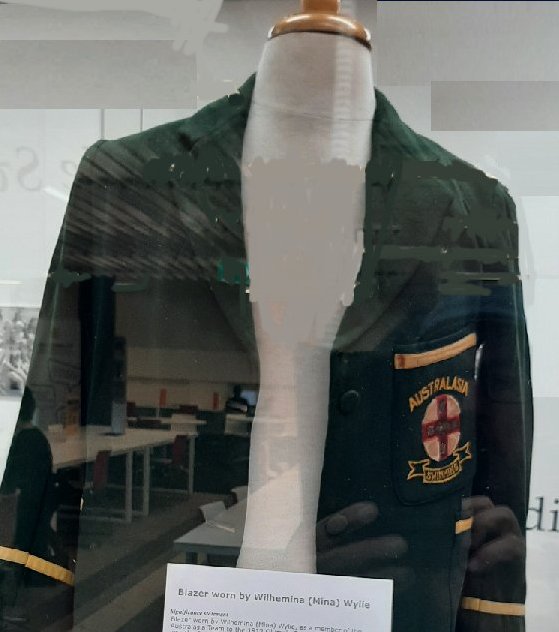
Mina Mylie Wylie's Olympic blazer from the 1912 Stockholm Games, in a 2023 exhibition. The emblem on the pocket reads "Australasia - Swimming". The design of the emblem bears not relation to the design of the Australasian Olympic Flag. This was the first Olympics where women were allowed to compete in swimming, and she won the silver medal for the 100m. (Fanny Durack won the gold). (From the collection of the Randwick and District Historical Society Inc.) In 1920, the first Australia-only Olympic team competed at the Antwerp Games. Australia sent a 13-member team winning two silver medals and a bronze. It is not clear whether they marched under the blue or red ensign. The red ensign was used during the 1936 Berlin Games. During the 1940s, the Chifley federal government officially recognised the blue ensign as the Australian national flag, and the red ensign as the maritime ensign. The blue ensign should have been carried by Australian Olympic teams since then. 
 Australian Blue & Red Ensigns
References Copyright © Coogee Media All rights reserved
|