HISTORY | STORIES | BEYOND BLOG & CREATE PEOPLE |
Berend Van der Struick's Adelaide SculptureCarved in Maroubra Sandstone:What a piece of rock can tell us about the history of a city
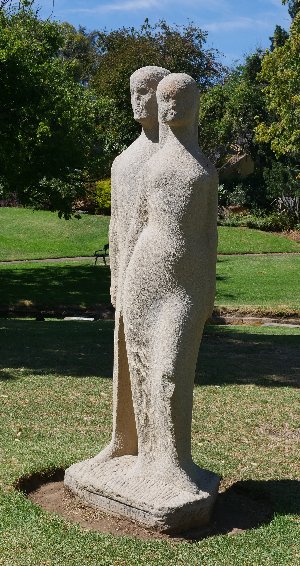
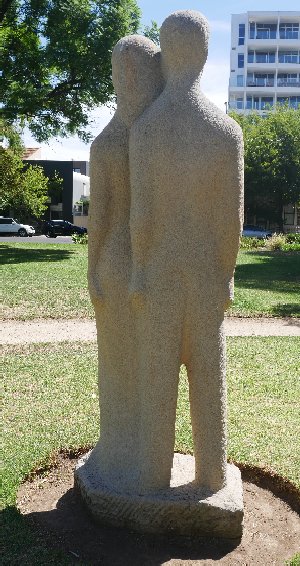
Berend Van der Struick's sculpture The Couple in Adelaide
Cautious & Conservative It had only been a couple of decades earlier when one of the pillars of Adelaide society, Sir John Langdon Bonython donated the then staggeringly large amount of money of £100,000, personally, to allow the impecuniousness South Australian state government to complete its half-finished State Parliament and a build the House of Assembly wing. Bonython was the proprietor and editor of the city's leading newspaper, The Advertiser and to this day that newspapers' political correspondents have unique and sole access to their own press gallery in the House of Assembly. Correspondents from other media organisations still must make do with sharing the common press gallery. Another donation made by Bonython was for £50,000 to build and large concert hall at Adelaide University, now known as Bonython Hall, to allow public performance of classical music favourites. Folklore has it that Bonython, a man of great public spirit but also one of conservative artistic tastes, had the hall built with a sloping floor to ensure that it could not be used for popular entertainments such as dancing. Sue remembers as a child visiting relatives in Adelaide from Sydney in 1960. "It was a quiet town then. At night my father drove the family up to a lookout in the Adelaide hills to observe the nightly event of the city's streetlights being turned off. Promptly at 10.30pm, the twinkling mass of urban lights disappeared. Driving back down to our accommodation in the city, we travelled through darkened deserted streets, save only for another occasional late-night motorist, or for a narrow shard of light escaping from curtains not fully drawn"
Adelaide Changing
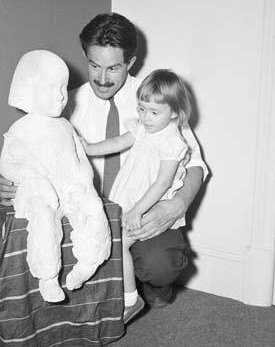 Berend Van der Struick and daughter Saskia with clay model of a statue of her used in his first exhibiton (Photo: NAA) Into this regional city came an artist: Dutchman Berend Van der Struik. Van der Struik was born on 24 July 1929 in Beilen in the Netherlands. He studied at the Akademie voor Industriele Vormgeving Eindhoven and the Academie de la Grande Chaumiere (Paris). He emigrated to Adelaide in 1957 with his wife Antonia and daughter Saskia as part of the Australian Netherland Migration Agreement and they lived there until 1964. He was a teacher, designer, and sculptor, and quickly made an impact on the local art scene. The inaugural Adelaide Festival of 1960 included a small exhibition of sculpture which included a piece by Van der Struick and his work was featured in the first Mildura Sculpture Prize in 1961. He was involved in the founding of the Adelaide School of Art and produced a sculpture for Adelaide's Union Hall. Van der Struick's sculpture "The Couple," also known as "The Embrace" is a sandstone sculpture was completed in 1962 and features two figures, a man and a woman in a close embrace, said to represent an early colonial settler couple. It is his best-known work. When Van der Struik began working on his sculpture, after 30 hours work, he found that the sandstone pieces that were provided were too soft and easily split and cracked. After much research, he heard of the wonderful qualities of the sandstone from the quarry at Maroubra and acquired stone for the work.
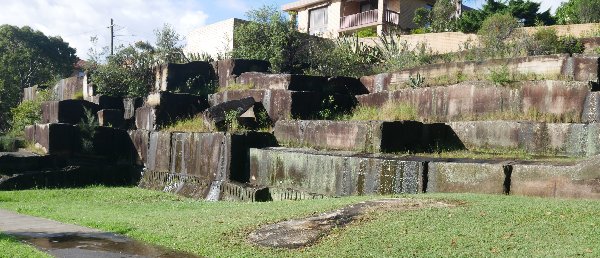
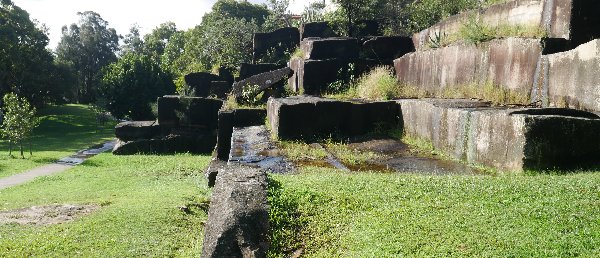
Maroubra Sandstone Maroubra quarry was located between Moverly Road and Storey Street (opposite Flower Street) and operated from 1917 to 1970. It was first worked by the New South Wales state government, supplying stone for important public works, but then taken over by Hawkesbury Sandstone Pty. Ltd. and later by Gosford Quarries Pty Ltd. Quarries were dotted about Randwick in the early to mid-20th century. One, for instance, was on the corner of Alison Road and Beach Street, Coogee in the early 20th century evidenced by the cuttings of sheer sandstone walls on the boundaries the Beach Street properties.
Sandstone from the Maroubra Quarry was used in the building of many important public buildings in Sydney including the State Library of New South Wales, Central Railway and the Australian Museum.
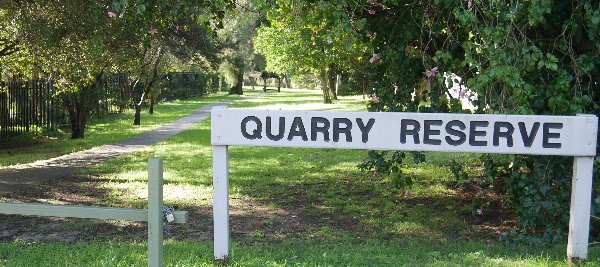
Quarry Reserve, Maroubra After his time in Australia, van der Struik returned to the Netherlands, where he continued to create art until he died in Hoorn on 25 September 1977.
It's intriguing to consider how Adelaide's cultural landscape has evolved since then. What was once controversial is now a beloved feature of Adelaide's Veale Gardens, even serving as a popular wedding location. It's a testament to how public perception of art can shift over time. References
|
Copyright © Coogee Media All rights reserved
| CONTACT US | ABOUT US |