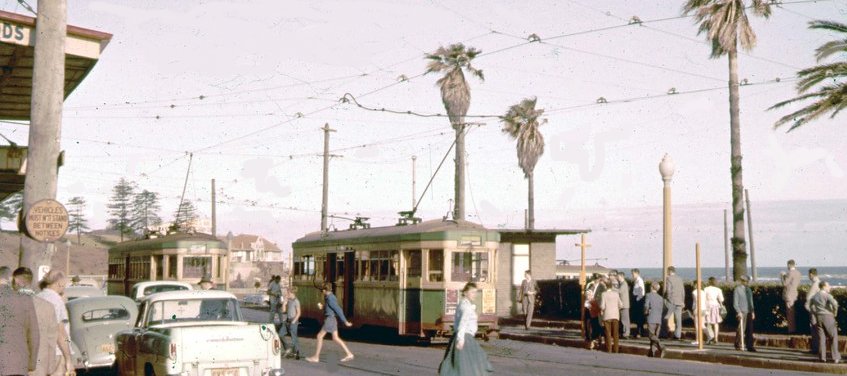
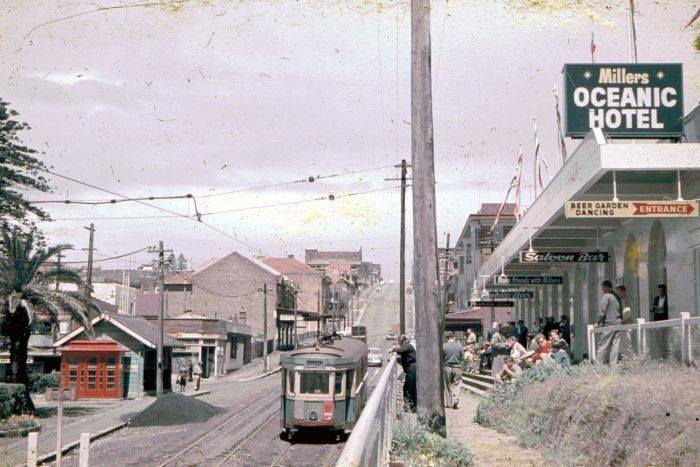
Trams at Dolphin Street Terminus c 1960 Known locally as "The Bundy", where tram staff logged on and off
When the Trams Came to Coogee
The introduction of trams saw Coogee change from sleepy beach town and swept into the modern age. It became a suburb of Sydney, plugged into the pulse of a growing city.
The first trams arrived in Coogee on 24 January 1883, extending the steam-powered line from Randwick Racecourse to the beach terminus at Dolphin Street. This marked a turning point for the
suburb, transforming it from a quiet coastal retreat into a bustling destination for day-trippers and holidaymakers. The route down from Randwick were especially popular with
swimmers who would pack early morning runs with towels and the modest swimwear of the era to take an early morning dip in the surf before the start of the business day.
Electrification came nearly two decades later - in 1902 when Coogee was officially connected to Sydney's electric tram network. The new electric trams ran from the city via Anzac Parade
and Alison Road, gliding beside Centennial Park before descending into Randwick and through the Spot. The electrification upgrade made travel faster, smoother, and more frequent, ushering
in a golden age of beachside leisure.
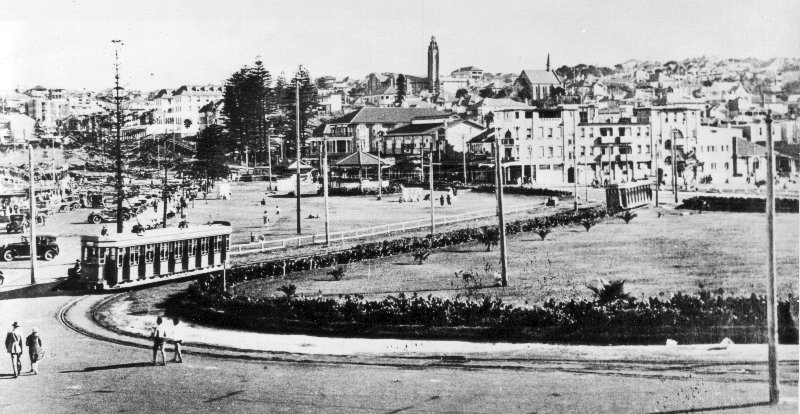
Tram terminus at Goldstein Reserve mid-1920s
Route
After running down St Paul's Street, the tram tracks entered a special tramway
reserve at what is now 11a Dudley Street, Coogee. The line in this reserve ran along over Carrington Road, and then parallel to Stark Street, crossed Melody Street and then ran
diagonally along a path next to Coogee Public School to enter Carr Street near the corner of Byron Street. At the corner of Havelock Avenue, the trams then continued through a cutting along a short
tramway reserve and under the Brook Street bridge until they reach a small commercial area at the eastern end of Havelock Avenue. It then took a left into Arden Street, down past
the Oceanic and Coogee Bay Hotels, and onward to the sea.
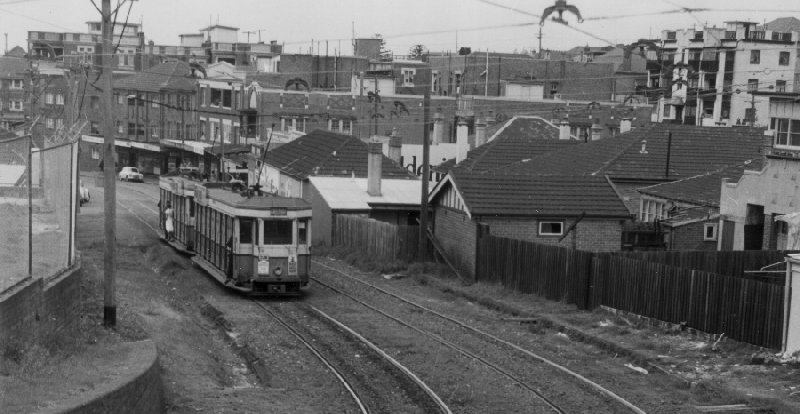
Tram from Coogee Beach entering Havelock Avenue Cutting, 1953
Heydays of the 1920s and 1930s
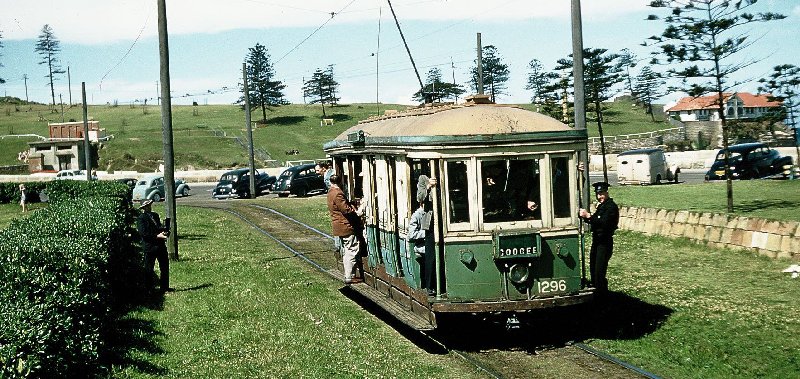
On hot summer days during the 1920s and 1930s, the trams were packed with day trippers wanting a day in the surf. Trams to Coogee were bursting with beachgoers carrying towels, umbrellas, and picnic baskets,
and surf-o-planes. Coogee was developing as a holiday destination and entrepreneurs and municipal authorities were doing their best to promote tourism and attract crowds with the building of the short-lived Coogee Pier,
floodlit night surfing and a shark-proof enclosure. There was a glamourous appeal to arriving at Coogee by tram.
Dangerous
Sydney's old trams could be dangerous, and accidents were not uncommon, ranging from collisions and derailments to tragic fatalities.
Noted musician, teacher, and local resident Isaac Nathan (Nathan Street is named after him) was an early tram fatality. At 5 pm on the afternoon of 15 January 1864, Professor Nathan
was on the Pitt Street horse tram, on his way home. As he stepped from the tram at Goulburn Street, it moved suddenly forward, and he fell underneath and was crushed to death. Another death
was that of a young tram conduction Allan Sauder-McIvor who was accidentally crushed to death between two passing trams in Arden Street Coogee on 4 January, 1935. Then in 1924 a six year old boy,
Norman Veness, was tragically killed when he fell from a tram near his home in Beach Street. There was little physical separation between the trams and motor and pedestrian traffic and the practice
of staff and passenger riding the outside running boards was fraught with danger. There are many newspaper accounts of collisions, accidents and deaths involving local trams.
Decline
The ravages of the Depression and the Second World War saw transport authorities skimp on investment in the tram network and maintenance was let slide. By the later 1949s, it was felt that
investment required to renew the tram network was took great a cost to bear. The rise in private ownership of motor vehicles increased competition to public transport, and the motoring
public clamoured for bigger and better roadways. There was a cultural shift where cars were marketed as symbols of modernity, independence, and prosperity.
The tram network, despite being efficient, was cast as old-fashioned and a hindrance to Sydney's progress. The motoring lobby in mid-20th century Sydney strongly supported the removal of trams,
seeing them as outdated obstacles to car traffic and pushed for a city designed around automobiles, buses, and highways rather than fixed rail lines. The State made the decision: trams would go
in favour of better roads.
Discontinued
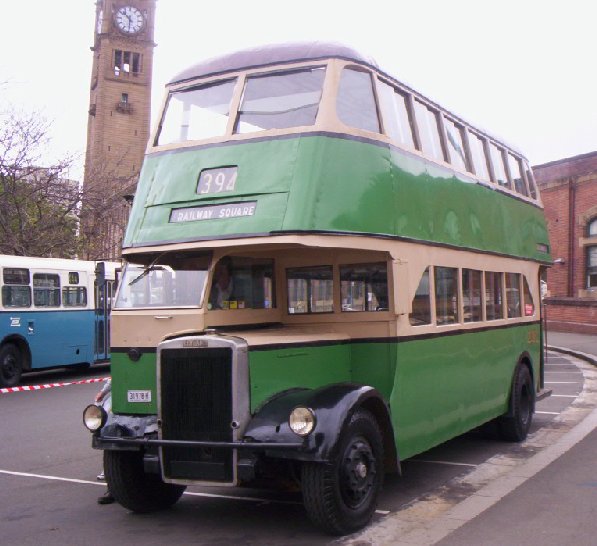
The last tram ran from Coogee on the 25th September, 1960. Bus route 373 ran roughly the same route to Coogee Beach as the trams had travelled. During the 1940s to 1950s Sydney acquired large numbers of Leyland OPD2 double-decker buses.
They were of a classic "half-cab" silhouette with the driver in the open-side cab and a conductor at the rear platform.
Still using the green and cream livery of the old tram system, they became a familiar sight in Coogee and nearby suburbs until replaced by single-deck buses in the later 1960s.
In the early 1970s the livery of the buses changed to a blue and white design scheme, the modern colour identity that Sydneysiders now associate with public bus services.
Leyland OPD2 double‑decker bus in green and cream livery
The became a common sight in Coogee
Route 394 ran from Central Station to La Perouse
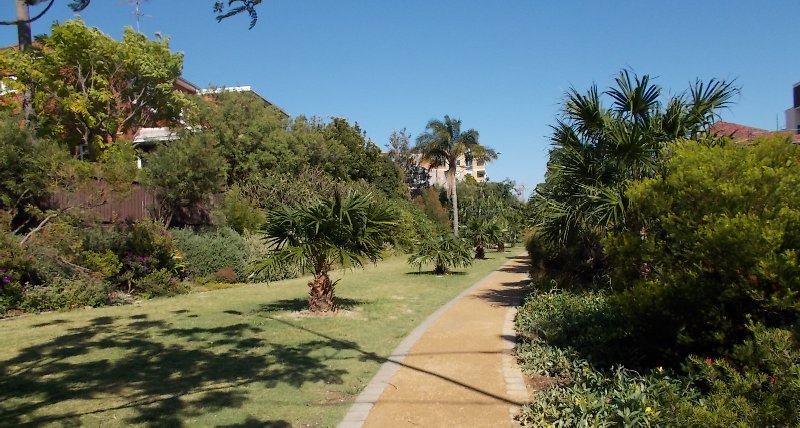
The tramway reserve from Dudley Street to Melody Street
is now a pleasant public reserve. The first section from Dudley Street to Melody have been transformed into beautiful gardens maintained by volunteers.
The 110 metre section from Melody to Carr Street has been incorporated into the playground of Coogee Public School (known as their Centenary Playground) and is no longer open
to the public. The old tramway reserve connecting Carr Street to Havelock Avenue is now a regular roadway (although lacking any pedestrian access because of its original design).
Buses did not have the passenger capacity, and charm, of the trams and fewer people visited Coogee in the next couple of decades. Coogee's identity leaned more toward being a quieter, family‑oriented beach suburb rather
than a bustling tram terminus for tourists. During the 1960s through to the mid-1980s, Coogee locals embraced the slower pace of suburban life, and tended to boast about its "village feel".
Old tramway reserve running from Dudley Street, now parkland maintained by volunteers
References
'Death of tram conductor', The Labor Daily (Sydney), Fri 4 Jan 1935, Page 7
'Child's death', The Daily Telegraph Tue 5 Feb 1924, Page 8